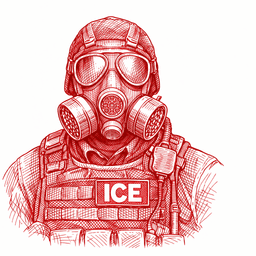
The ICE Crackdown
Drag entities to build your map
Collections
How to Use the Map
This investigation tracks 65 entities and 90 documented connections. Use the sidebar to browse and filter entities by type, collection, or search. Click any node on the canvas to see detailed information about that entity and its connections. Switch between Canvas, Timeline, and Map views to explore the data from different angles.
Toggle minor figures on or off to focus on key players, or use the tag filters to narrow your view. Click any connection line to see the evidence and sources supporting that relationship.
Understanding Fact-Check Status
Every entity and connection in this investigation is assigned a fact-check status based on the strength and reliability of available evidence.
Verified
Confirmed by multiple independent, high-quality sources.
Credible
Supported by reliable sources with consistent evidence.
Claimed
Reported but not independently verified; based on limited sources.
Disputed
Conflicting evidence exists; sources disagree on key details.
Debunked
Disproven by strong counter-evidence or retracted by original source.
In January 2025, the Trump administration launched the largest immigration enforcement campaign in modern American history. Under Border Czar Tom Homan, DHS Secretary Kristi Noem, and policy architect Stephen Miller, ICE and CBP began mass raids across American cities, workplaces, schools, and churches — after rescinding decades-old protections for sensitive locations on Day One.
The Scale
Operation Safeguard launched in January 2025 with 538 arrests across 9 cities. By September, Operation Midway Blitz arrested over 1,800 people in Chicago. In December 2025, Operation Metro Surge deployed 2,000+ CBP agents to Minneapolis, arresting over 3,000. A September 2025 raid at a Hyundai plant in Georgia arrested 475 workers — the largest single-site workplace raid in DHS history. Arrests of people with no criminal record surged 2,450%. The detention population hit an all-time high of 66,000.
American Victims
At least 30 shootings by immigration agents since January 2025 have resulted in at least 8 deaths. At least 5 of those shot were U.S. citizens. On January 7, 2026, ICE agent Jonathan Ross shot and killed Renee Good, a 37-year-old American mother of three, in Minneapolis. Seventeen days later, CBP agents Jesus Ochoa and Raymundo Gutierrez shot and killed Alex Pretti, a 37-year-old VA ICU nurse, also in Minneapolis. In Chicago, U.S. citizen Marimar Martinez was shot 5 times by Border Patrol and survived — later testifying to Congress: "My own government attempted to execute me."
Illegal Deportations
In March 2025, the administration invoked the Alien Enemies Act of 1798 to deport 238 Venezuelans to El Salvador's CECOT mega-prison — bypassing courts entirely and defying a federal judge's restraining order mid-flight. Kilmar Abrego Garcia, who had a court order protecting him from removal, was sent to CECOT. The Supreme Court unanimously ruled it illegal. He was returned in June but immediately indicted on smuggling charges his lawyers call "vindictive prosecution."
The Resistance
The killings of Good and Pretti ignited a firestorm. On January 23, 2026, Minneapolis saw the first U.S. general strike in 80 years — 50,000+ people marched in -20°F weather, 700+ businesses closed. On January 30, the National Shutdown brought 300+ protests to cities nationwide. Newark Mayor Ras Baraka was arrested at an ICE facility (charges dismissed). Minnesota AG Keith Ellison filed federal lawsuits. Chicago Mayor Brandon Johnson created "ICE-Free Zones." A PBS/Marist poll found 65% of Americans said ICE had gone too far.
Targeting Dissent
The administration targeted students and activists through immigration enforcement. Columbia green card holder Mahmoud Khalil was arrested without a warrant and detained 104 days. Tufts PhD student Rumeysa Ozturk was grabbed by six masked agents for co-authoring a student newspaper op-ed. Columbia student Mohsen Mahdawi was arrested at his own citizenship interview. Don Lemon was arrested on federal charges after a church protest. 32 journalists were detained in 2025 alone.
This Map
This interactive visualization maps the architects, operations, victims, resistance leaders, and legal battles of the ICE crackdown. Sources include court records, government statements, bystander video, social media documentation, and investigative journalism.
The Architects
The mass deportation campaign that has defined the second Trump presidency did not materialize overnight. It was designed, staffed, and methodically executed by a small circle of hardliners who spent years planning for this moment. Explore the Architects collection on the map to see how power flows from the White House to the streets.
At the center sits Stephen Miller, the White House Deputy Chief of Staff for Policy, widely called the “mastermind” of the crackdown. Miller runs daily 10 a.m. calls — including Saturdays — demanding arrest updates from field offices. In May 2025, he directed ICE to hit 3,000 arrests per day. Only 17% of Americans view him favorably.
Tom Homan, appointed “border czar” in November 2024, serves as the public face of enforcement. Homan pushed for the 3,000-arrest-per-day target, oversaw CECOT deportation flights that defied a court order, and was dispatched to Minneapolis in January 2026 to take command after two Americans were killed. In February 2026, he announced a partial withdrawal of 700 agents from Minnesota.
Kristi Noem was sworn in as DHS Secretary on January 25, 2025, and personally joined ICE agents on Minneapolis raids. She oversaw Operation Metro Surge deploying 2,000+ agents and claimed 622,000+ removals — figures disputed by journalists. An impeachment resolution (H.Res.996) has been introduced against her.
Beneath them, Todd Lyons, Acting ICE ERO Director since March 2025, authored a secret memorandum instructing agents they may enter homes by force based solely on administrative warrants — leaked by DHS whistleblowers. He compared mass deportations to “Amazon trying to get your Prime delivery within 24 hours.” A federal judge found he violated at least 96 court orders in Minnesota since January 2026 alone.
President Trump signed the Laken Riley Act as his first bill, invoked the Alien Enemies Act of 1798, deployed the military to American cities, and rescinded sensitive-location protections on Day One. After the killings of Renee Good and Alex Pretti, he stated they “should not have happened.”
The Operations
The crackdown unfolded across American cities in a series of named operations, each escalating in scale and aggression. View the Major Operations collection to trace the campaign's geographic sweep.
Operation Safeguard launched in January 2025 as the first major action — coordinated by ICE field agents out of Chicago, bypassing Biden-era leadership. Multi-city raids on January 23 hit Atlanta, Boston, Denver, Miami, New York, Newark, Philadelphia, Seattle, and Washington, D.C. 538 immigrants were detained.
By September, Operation Midway Blitz descended on Chicago with over 1,800 arrests. During this operation, Silverio Villegas Gonzalez was shot and killed by ICE during a traffic stop in a Chicago suburb — bodycam footage showed the agent describing injuries as “nothing major,” contradicting DHS's initial account. U.S. citizen Marimar Martinez was shot five times by a Border Patrol agent; she survived and later testified before Congress: “My own government attempted to execute me.”
The largest operation — Operation Metro Surge — launched in Minneapolis in December 2025 with approximately 3,000 federal agents, more than Minneapolis and St. Paul police forces combined. DHS called it “the largest immigration enforcement operation ever carried out.” Only about 5% of those arrested had violent crime records.
The Hyundai plant raid in Ellabell, Georgia, on September 4, 2025, was the largest single-site workplace enforcement action in DHS history — 475 workers arrested, predominantly South Korean nationals. Images of handcuffed Korean workers sparked a diplomatic dispute with Seoul.
And in Chicago on November 5, 2025, armed ICE officers chased a teacher into Rayito de Sol preschool and arrested her as parents and children looked on. Interior camera footage became one of the most viral moments of the crackdown — a symbol of the abandonment of sensitive-location protections.
Americans Killed and Wounded
Since January 2025, there have been at least 30 shootings by immigration agents, resulting in at least 8 deaths. Among the dead are American citizens with no connection to immigration enforcement. The American Victims collection documents those killed and wounded.
Renee Good
Renee Nicole Macklin Good, 37, a U.S. citizen and mother of three, was shot and killed on January 7, 2026, by ICE agent Jonathan Ross during Operation Metro Surge in Minneapolis. Ross fired three shots as her car moved forward. Bystander video went viral — a Quinnipiac poll found 82% of registered voters saw the footage. Minneapolis Police Chief Brian O'Hara called her killing “predictable and preventable.” Her death was the primary catalyst for the Minnesota general strike.
Alex Pretti
Alex Jeffrey Pretti, 37, a U.S. citizen and ICU nurse at a VA hospital, was shot and killed on January 24, 2026, in Minneapolis's Whittier neighborhood by two CBP agents identified by ProPublica. Pretti was filming agents with his phone and stepped between an agent and a woman pushed to the ground. He was pepper-sprayed, wrestled to the ground by approximately six agents, then shot — 10 shots in under five seconds. DHS claimed he had a handgun; multiple bystander videos verified by Reuters showed no weapon. The Hennepin County Medical Examiner ruled his death a homicide. The DOJ opened a civil rights investigation.
Marimar Martinez, 30, a U.S. citizen, was shot five times (seven wounds) by a Border Patrol agent in Chicago during Operation Midway Blitz. She survived and told Congress: “My own government attempted to execute me.” Silverio Villegas Gonzalez, 38, was shot and killed by ICE during a traffic stop in a Chicago suburb — the bullet traveled through the back of his neck.
Illegal Deportations
The administration deported people in defiance of court orders, invoked a 1798 wartime law last used for Japanese internment, and sent deportees to a foreign mega-prison. The Illegal Deportations collection maps these cases.
Kilmar Abrego Garcia, a Salvadoran immigrant married to a U.S. citizen with legal protection from deportation, was illegally deported in March 2025 to CECOT, El Salvador's mega-prison. The Justice Department admitted the deportation was “in error.” The Supreme Court unanimously ruled it illegal on April 10, 2025, with Chief Justice Roberts ordering the government to “facilitate” his return. Abrego Garcia was returned in June 2025 — but immediately indicted on smuggling charges in what his defense calls “vindictive prosecution.”
The administration invoked the Alien Enemies Act of 1798 to deport alleged members of Tren de Aragua without court proceedings. 238 Venezuelans were deported to CECOT. Flights departed despite a federal judge's temporary restraining order. An appeals court blocked further use in September 2025, and a judge ruled the deportations violated due process in December 2025. President Bukele of El Salvador offered CECOT to the U.S. for deportees. CBS News pulled a completed 60 Minutes investigation into torture allegations at the prison hours before airing.
Targeting Students and Dissent
The crackdown extended beyond immigration enforcement to target student activists, journalists, and elected officials. The Students & Dissent collection documents these cases.
Mahmoud Khalil, a Palestinian lawful permanent resident and Columbia graduate student, was arrested from his Manhattan apartment by ICE agents who entered without a judicial warrant. ACLU surveillance footage showed he was fully cooperative — contradicting DHS claims he tried to flee. He was detained 104 days at a facility in Jena, Louisiana, before a judge ruled his detention unconstitutional. He filed a $20 million damages claim.
Rumeysa Ozturk, a Turkish PhD student at Tufts University studying child development, was arrested by six masked plainclothes DHS agents after her F-1 visa was revoked. The apparent basis: co-authoring a student newspaper op-ed calling for divestment from companies tied to Israel. She was transported 1,600 miles to a detention center in Louisiana before a judge ordered her release.
Mohsen Mahdawi, a ten-year legal U.S. resident and Columbia student, was arrested at his U.S. citizenship interview — he was literally at his appointment to become a citizen. The administration argued it could deport him for protest activity. A federal judge ordered his release.
Don Lemon, the former CNN anchor, was arrested at a Beverly Hills hotel where he was covering the Grammys, charged in connection with a Minnesota anti-ICE protest. Attorney General Pam Bondi stated the arrest was made “at my direction.” Minnesota's Chief Judge wrote that Lemon was “not a protester at all” with “no evidence” of criminal behavior. His attorney called it “an unprecedented attack on the First Amendment.”
The Resistance
The killings of Good and Pretti ignited a resistance movement not seen in the United States in decades. The Resistance collection maps the people, protests, and movements that pushed back.
The Minnesota General Strike on January 23, 2026, was the first general strike in the United States in approximately 80 years. Over 50,000 people marched through downtown Minneapolis in temperatures as low as -20°F. More than 700 Minnesota businesses closed in solidarity. Approximately 100 clergy were arrested at a protest against deportation flights. Bruce Springsteen released “Streets of Minneapolis” on January 28, honoring Good and Pretti — it reached #1 on iTunes in 19 countries.
A week later, the National Shutdown on January 30, 2026, brought 300+ protests to cities across the country. A PBS/Marist poll found 65% of Americans said ICE had gone too far.
Mayors and governors defied the administration. Newark Mayor Ras Baraka was arrested at an ICE detention facility while attempting oversight — a judge dismissed the charges, calling the arrest “hasty” and “a worrying misstep.” Governor Tim Walz demanded Trump remove “untrained” federal agents from Minnesota. Chicago Mayor Brandon Johnson created ICE-Free Zones and called for a coordinated nationwide protest movement. Minnesota AG Keith Ellison filed a federal lawsuit alleging Minnesota was targeted for its voting habits and political viewpoints, calling the crackdown “politics and retribution.”
StopICE.net, a nationwide mobile alert platform with 500,000+ subscribers, provided real-time ICE raid notifications until it was hacked on January 29, 2026 — hackers claimed they sent user data to the FBI. StopICE traced the attack to a CBP agent's personal server.
Legal Battles
The courts have served as the primary check on the administration's enforcement campaign, though compliance has been inconsistent. Explore the Legal Battles collection for the key cases.
The ACLU has filed multiple lawsuits challenging the crackdown — releasing surveillance footage proving ICE lied about Mahmoud Khalil's arrest, challenging Operation Metro Surge for racial profiling, and suing over an operation in Kern County that targeted Latino farmworkers.
The Supreme Court unanimously ruled the Abrego Garcia deportation illegal and has accepted the birthright citizenship case for oral arguments in April 2026. Chief Justice Roberts authored the Abrego Garcia opinion, drawing a careful distinction between “facilitating” and “effectuating” a deportee's return.
Public Counsel, a Los Angeles-based legal organization, won a federal injunction requiring ICE to provide attorney access to detained individuals. A federal judge ruled the military deployment to Los Angeles violated the Posse Comitatus Act. In Minnesota, a federal judge found ICE violated at least 96 court orders since January 2026 and ordered Todd Lyons to appear in court.
The Laken Riley Act, signed as the first bill of Trump's second term, mandates detention of undocumented immigrants accused — not convicted — of certain crimes and gives states the right to sue the federal government over immigration. By December 2025, 17,500 arrests had been made under its authority.
By the Numbers
30+
Shootings by immigration agents since January 2025
8+
Deaths from enforcement shootings
2,450%
Surge in arrests of people with no criminal record
66,000
All-time high immigration detention population
96+
Court orders violated by ICE in Minnesota (Jan 2026)
65%
Americans who said ICE had gone too far (PBS/Marist)